Play
Outdoor play for toddlers
Toddlers need to move. Your job is a place they can run and an adult who can still see the street.
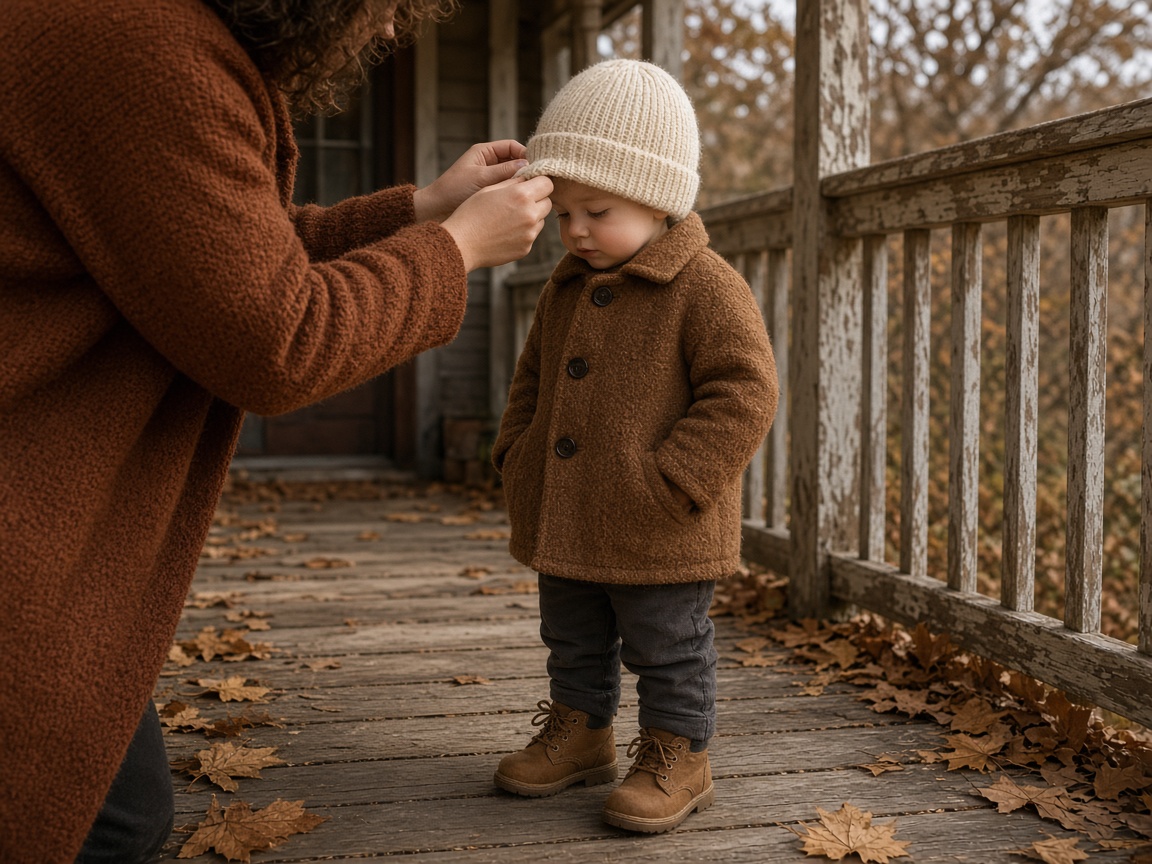
An adult in a rust cardigan ties a cream knit hat on a toddler in a brown wool coat and boots on a wooden porch scattered with autumn leaves.
Outdoor time also steals minutes from screens without a lecture. AAP's hour for ages 2 to 5 is easier to keep when the day already had a walk to the corner and a stick collection.
Safety still travels with you. Streets, dogs, water, and heat are the list. A fenced space is kinder than a speech about not running. If you do not have a fence, your body is the fence.
Try this
- Pick a daily outdoor slot that survives bad moods: after the nap, before dinner.
- Bring a snack and leave before the crash if you can.
- Let them stop for dirt. Dirt is the curriculum.
- Dress for the weather you have, not the weather you wanted.
- If the park is too much, walk the block and name three things you see.
Winter still counts. A ten-minute porch sit in a coat is outdoor play. Summer needs water and shade. Read the water post before you trust a kiddie pool.
Other children at the park are optional. Parallel play can happen next to a stranger's stroller or not at all. You came for the movement. The friendship montage can wait.
In the house this month
A stroller nap on a walk can steal the afternoon nap. If you need the afternoon nap, walk after it. If you need the walk more, take the stroller nap and move bedtime earlier.
Dogs that are sweet with adults are not automatically safe with a lurching toddler. Ask the owner. Keep your body between the faces.
Heat and cold both end play sooner than your plan. Shade, water, a hat. Then go in. A shorter outdoor time that happens is better than a long one you fear.
The same corner every day is enough. Children this age do not need a new destination. They need to run the same three steps until the steps are theirs.
What you can skip
Skip a new destination every day. Skip a long park visit that always ends in a crash.
Skip treating a dog as automatically safe. Keep your body between faces.
Keep the range in view
Moving bodies, ordinary dirt, an adult who can see the street. The same corner every day is enough. Heat, cold, dogs, and water travel with you. A stroller nap can steal the afternoon nap.
Keep the range in view
Winter still counts. A ten-minute porch sit in a coat is outdoor play. Summer needs shade and water. Read the water post before you trust a kiddie pool.
Check in if
If your child cannot run, climb a couch, or enjoy being outside because of pain or fear, ask your pediatrician. Disliking rain is ordinary.
Related ages: 12-18 months, 18-24 months, 24-36 months. Pillars: Sleep, Behavior.
Sources
- CDC. Positive parenting tips: toddlers (1 to 2 years). cdc.gov
- CDC. Milestones by 2 years. cdc.gov/act-early/milestones/2-years.html
- CDC. Milestones by 30 months. cdc.gov/act-early/milestones/30-months.html
- AAP Council on Communications and Media. Media and Young Minds. Pediatrics. 2016;138(5):e20162591. publications.aap.org