Media
Screen time limits ages 2-3
Your job is to keep screens from eating the day. Play, talk, meals, and sleep come first. An hour is a ceiling, not a target.
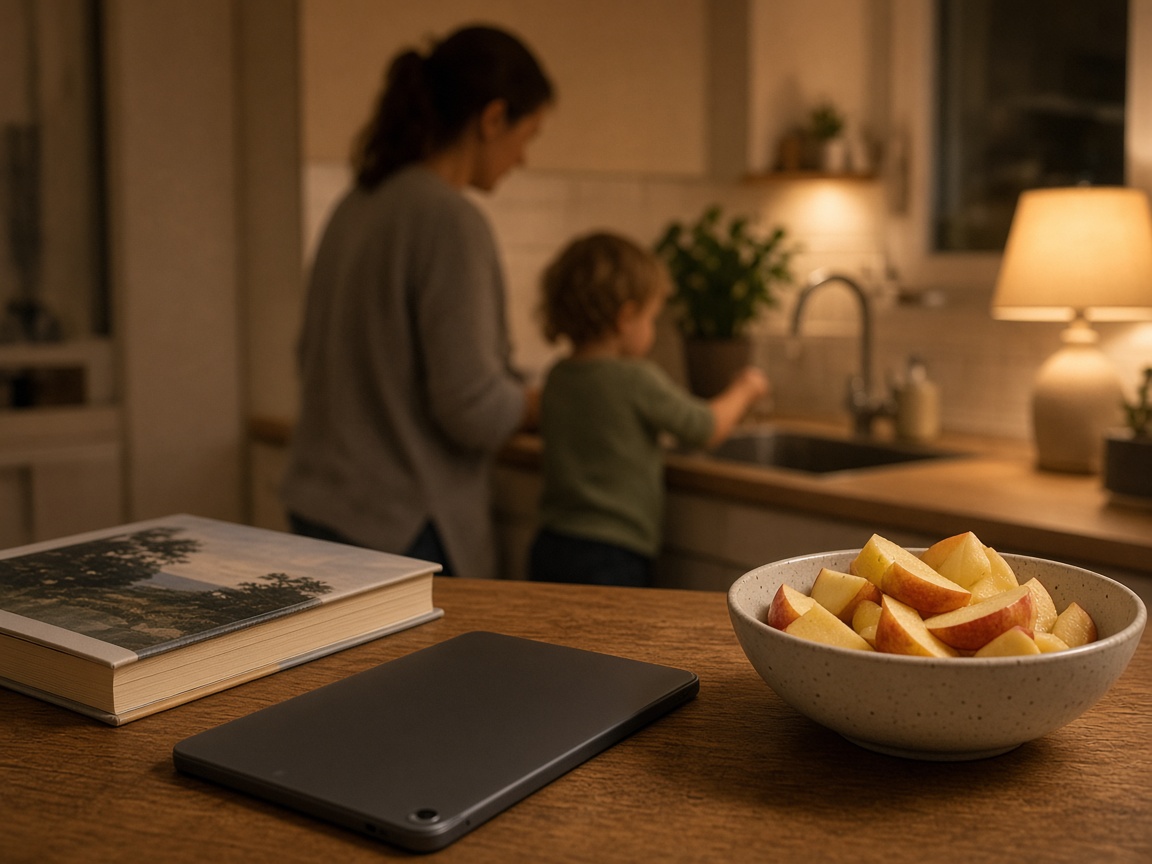
A tablet lies face-down on a wood table beside a hardcover book and a bowl of apple slices. In the background, an adult and toddler stand at a kitchen sink.
An hour is easy to spend before breakfast if a phone becomes the off-switch for every transition. Decide the hour before the tablet comes out. Sit with them. Name what you both see so the show becomes talk. That is the part families skip, and it is the part AAP is actually asking for.
Background television still counts as a screen in the room. It pulls adult eyes and toddler eyes. Turn it off when no one is watching it on purpose. A quiet kitchen is not deprivation. It is how a 2-year-old hears the words you are already saying.
Try this
- Decide the hour before the tablet comes out.
- Sit with them and name what you both see.
- Keep screens out of bedrooms and off the table.
- Turn the TV off when no one is watching it on purpose.
- If you need a calm-down tool, try a book, water, or a lap first.
In the house this month
Video chat with a grandparent is the exception AAP already carved out for younger children. A show playing while you cook is not that exception. If you need 20 minutes to make dinner, put the child in the room with you and a bowl and a spoon. It will be louder. It will also be a day that still had your face.
Other people's houses will have a television on. You can still sit with your child and name an end point. We will watch this, then we will go to the yard. Then do it. A child who never sees an ending will not invent one.
Your own phone is part of the room. A parent who looks at a screen while asking a child to look away is teaching a harder lesson than any policy statement. Put your phone in another room for the bedtime sequence. That is a household rule for adults.
If the hour is already gone by noon, the answer is not a second hour because the day was hard. The answer is a walk, a bath, or an earlier bedtime. Hard days need the boring tools more, not less.
What you can skip
Skip background television. Skip a tablet in the crib. Skip making the hour a reward for being good. That turns media into a trophy.
Skip arguing about one extra episode at the title screen. The decision belongs to the time before the tablet came out.
Keep the range in view
An hour is a ceiling for ages 2 to 5, with you in the room. Under 18 months, video chat is the main exception. The range is about protecting play and sleep, not about winning a contest for zero media.
Check in if
Talk with your pediatrician if screens are how every hard feeling ends, if sleep or meals only happen with a device, or if you cannot name what they watched today. This page restates AAP and CDC limits. It does not diagnose a media problem.
Related ages: 18-24 months, 24-36 months. Pillars: Sleep, Behavior.
Sources
- AAP Council on Communications and Media. Media and Young Minds. Pediatrics. 2016;138(5):e20162591. publications.aap.org
- CDC. Milestones by 2 years. cdc.gov/act-early/milestones/2-years.html
- CDC. Milestones by 30 months. cdc.gov/act-early/milestones/30-months.html
- CDC. Milestones by 3 years. cdc.gov/act-early/milestones/3-years.html
- CDC. Positive parenting tips: toddlers (1 to 2 years). cdc.gov