Play
Parallel play
Playing next to another child is real play. Your job is to protect both spaces and stay close enough to help with turns.
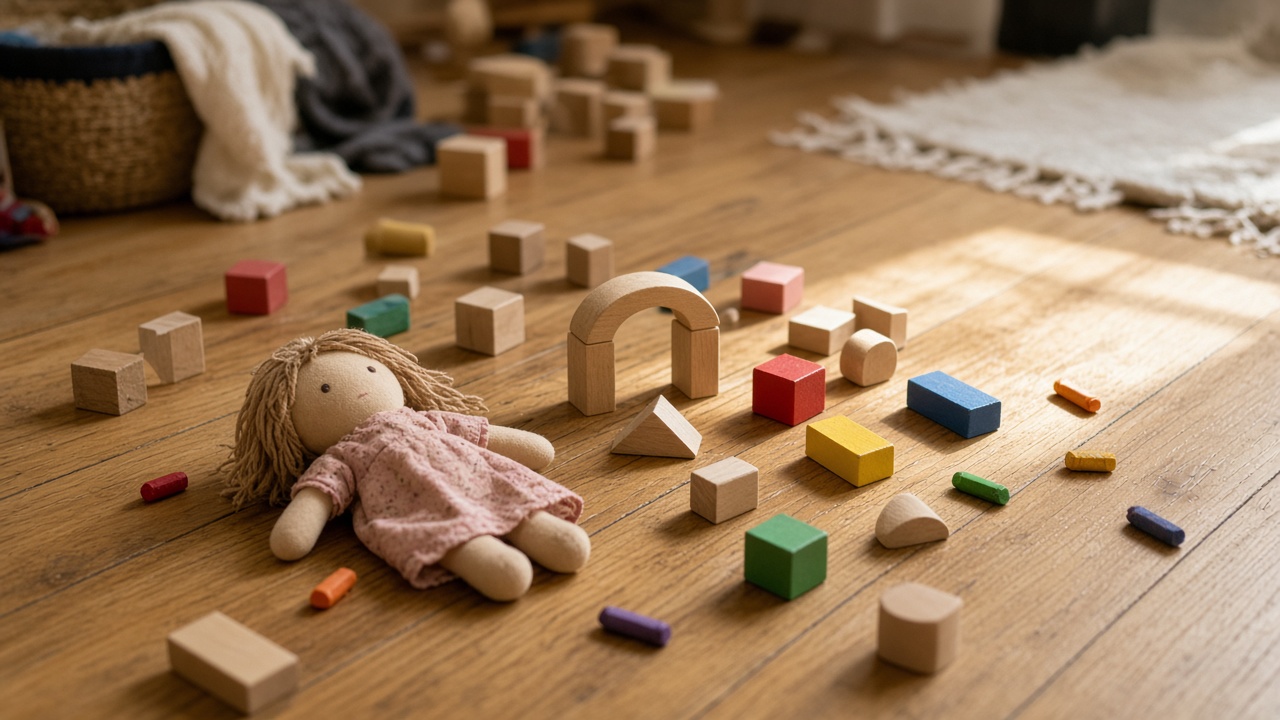
A rag doll in a pink dress lies on a hardwood floor among colorful wooden blocks and crayon stubs. A basket and a fringed rug sit in the background.
Parallel play looks dull to adults who wanted a friendship montage. Two piles of blocks, two trucks, two adults nearby. The learning is in the looking. A child who glances over and copies a stack is already in the curriculum.
Turns can start in this season with an adult narrator. They do not start with a lecture about kindness. Kindness is a word. A body that waits ten seconds is a skill.
Try this
- Offer two of the same toy when you can.
- Sit between children if grabs are likely.
- Name what you see: you have a red block. Sam has a blue block.
- Keep the visit short enough to end on a standing start.
- Do not force a shared project. Side-by-side is enough.
A child who prefers the corner with you is not failing social studies. Stay. Then move a few feet. Then stay again. The other child is optional. You are not.
CDC milestones by 2 years also includes noticing when someone is hurt. If your child looks at you when another child cries, answer that look. That is social play too. It just does not photograph as well as a group hug.In the house this month
A child who dumps the other child's pile is not hosting. Stay close enough to stop the dump. Then give the dumper a pile of their own. The lesson is not a speech about sharing. It is a second pile.
Parks make parallel play harder because toys are few and children are many. Bring two shovels. Leave when the grabbing starts. You can come back tomorrow.
If your child prefers to watch, let them watch. Watching is how some children enter. A shove into the circle will not speed that up.
Adults chatting on a bench are how bites happen. Sit on the edge of the play. You can still talk. You just have to be able to reach.
What you can skip
Skip forcing a shared project. Skip chatting on a far bench while bites happen.
Skip grading a 24-month-old on the 3-year join-in list.
Keep the range in view
Next to is real play at 2. Protect both piles. Stay close enough to reach. Do not grade a young two on joining in. Watching is an entrance. A far bench is how bites happen.
Keep the range in view
Bring two shovels to the park. Leave when grabbing starts. You can come back tomorrow. Parallel play does not require a friendship montage.
Keep the range in view
A child who prefers the corner with you is not failing social studies. Stay. Then move a few feet. Then stay again.
Check in if
If your child cannot stay in a room with another child after many short tries, or if play is absent at home too, ask your pediatrician at the visit.
Related ages: 18-24 months, 24-36 months. Pillars: Behavior.
Sources
- CDC. Milestones by 2 years. cdc.gov/act-early/milestones/2-years.html
- CDC. Milestones by 30 months. cdc.gov/act-early/milestones/30-months.html
- CDC. Milestones by 3 years. cdc.gov/act-early/milestones/3-years.html